
How to Manage Finances Wisely As Youngsters Under 30?
“Manage Finances Today To Save Comfortably Tomorrow”
It feels exciting to get your first salary, whether the money is made from a successful business deal, a freelance project, or even a small side hustle. A few days later, though, you may wonder where most of it disappeared. Rent is paid; transport costs money, and food is more expensive than expected. And somehow there’s little left to save.
Sounding similar?
That’s not an uncommon experience for a lot of young people. To manage finances in your twenties, it can be surprisingly difficult, particularly if you are trying to become independent and you have increasing living costs and family responsibilities to manage. In Ghana, where young adults are looking for jobs, entrepreneurship, and digital income opportunities, knowing how to manage money has become an important life skill.
What’s interesting is that financial stability doesn’t always start with earning more. Sometimes it starts with better use of what you already have.
Whether you are studying in Kumasi, working in an office in Accra, running a small shop in Tamale, or earning through online projects from your home, there are some practical ways to make your money go further before you turn 30.
Here are 10 Ways Through Which You Can Manage Finances Wisely
The main objective of listing these ways is to make each young adult financially stable in their 40s and later. Moreover, you can opt for any of the suitable ways as per your current situation.
1. Know what you really get in your pocket.
Making money is not the same as having money to spend. This difference may not be obvious to young professionals, especially when they are receiving their first regular salary. Suppose you are getting GH¢4,000 at the end of the month. At first, it might seem like a comfy amount. But once you factor in deductions like transport, food, rent contributions, internet bills, and other commitments, the balance can look quite different.

Freelancers have one other problem. One month you may have a few clients and good earnings; the next could be surprisingly quiet. Treating every pay cheque as disposable income? You’ll run into problems when work is down. To overcome this, you can follow these 3 easy steps:
Step 1: Write down your actual take-home income.
Step 2: Then add your business profits, allowances, and any regular side income to your salary.
Step 3: Separate the occasional gifts or payments that are not predictable.
This simple exercise will give you a much better picture of your financial situation. Figure out what you actually have before you figure out what you can afford.
2. Don’t follow budgeting rules that don’t fit your life.
You’ve probably heard of the 50-30-20 rule of budgeting. It recommends spending 50% of income on needs, 30% on wants, and keeping the remaining 20% for savings and financial purposes. Sounds simple enough, but life doesn’t always cooperate.
Accommodation and transport costs alone may take a large proportion of the salary of a young graduate lodging in a room in Accra. It might not be practical to expect that person to adhere to the same budget as someone who lives with their parents. Budgeting percentages are a guideline, not a hard and fast rule.
Create a list of your monthly expenses. Separate the things you can’t easily avoid (e.g., rent, groceries, and electricity) from the purchases you could postpone. Look honestly at your spending.
You may find that lots of little expenses are included in your income without you even knowing it. An unused subscription here, an online shopping binge there, and before you know it, it can all add up, as can the daily takeaway.
The point isn’t to stop enjoying your money. It is to understand which expenditure is worth prioritising.
3. Save Something, Even With a Small Salary
The mistake many young people make is waiting for a higher salary before they start saving.
There is always a reason to put it off. Maybe the next promotion will make saving easier, or maybe the business will be more profitable. Unfortunately, as income increases, expenses increase.
Begin with a sum that won’t make your monthly budget feel shortage. It could be GH¢50, GH¢100, or whatever you can manage. The first goal is to build an emergency fund, not a great investment portfolio.
Take, for example, a young nurse working in a hospital in Cape Coast. If something unexpected comes up, having some money saved can mean you don’t have to borrow straight away. The same applies to a freelance photographer who may have to wait weeks for the next payment.
Build up to three to six months’ worth of essential expenses. Keep this money separate from your daily spending money. Your emergency fund is for real mishappenings, not the enjoyable weekend shopping spree.
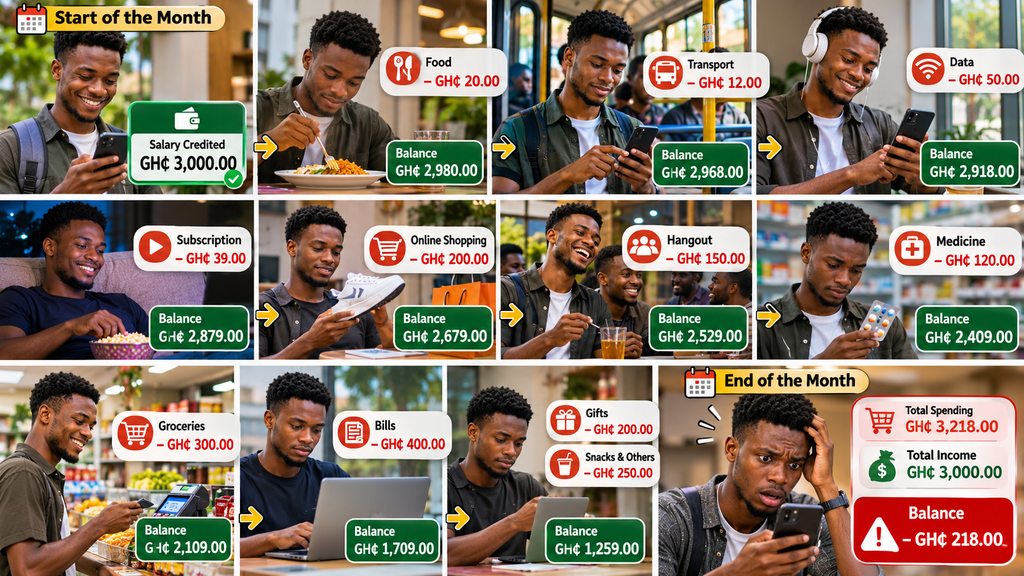
4. Use Mobile Money Wisely, Not Just Conveniently
In Ghana, mobile money has made transactions for daily life so much easier. People use it to receive salaries, pay bills, buy airtime, send money to relatives, and do business. But the ease of spending can sometimes create unnoticed extra expenses.
Consider how many times you make small transfers and don’t look at your balance. A few buys here, a subscription there, and a few transfers to friends can leave you wondering where your money went so quickly.
One practical solution is to segregate your everyday transaction money from your savings.
Avoid keeping all of your available funds in the account you use for daily purchases. Review your statements and check transaction charges before making frequent transfers. Of course, with digital convenience comes security duties, too. Do not share your mobile money PIN or one-time password with anyone claiming to help you resolve an account issue.
According to the Bank of Ghana’s Payment Systems Oversight Annual Report 2025, there were 80.5 million registered mobile money accounts, with 26.6 million accounts active. This shows how far digital payments have penetrated the financial space in Ghana.
Now the next step is learning to use these services with more financial discipline.
5. Your Money Plan Should Match Your Profession
Ways of earning are different for everyone. Monthly salary, freelance payment, and daily business income are three different things and need different approaches. These are:
If you work in an office:
As soon as you get your salary, put some of it into savings. If you wait until the end of the month, you often find out that there is nothing left. Also, research professional courses or certifications that could increase your future earning potential.
If you are a freelancer:
Don’t expect that after a good month there will be another profitable month. Record all payments, software subscriptions, internet costs, and other business expenses. When a client pays you, don’t spend all of that money right away.
If you have a small business:
Your sales numbers are not your personal income. For example, a trader in Kumasi has to consider stock bought, transport, rent, and other running expenses before he can decide how much profit can be withdrawn.
Your financial habits should be based on how you make money, not how someone else makes money.
6. Check For Family Members’ Responsibilities While Spending
In many Ghanaian and even other nations’ families, financial decisions usually are not made by any one individual. Perhaps a young adult is paying for a parent’s medical needs, helping a younger sibling with their education costs, or supporting family members through hard times. In preparing a budget, these responsibilities should be taken into account.
For someone living alone, saving can mean putting money aside for rent, food, and plans. When a young couple lives together, they have different priorities, such as shopping for the house, utilities, and joint savings.
Young parents need to look further ahead. School fees, healthcare, childcare,e and other unforeseen family costs can make planning financially more complex.
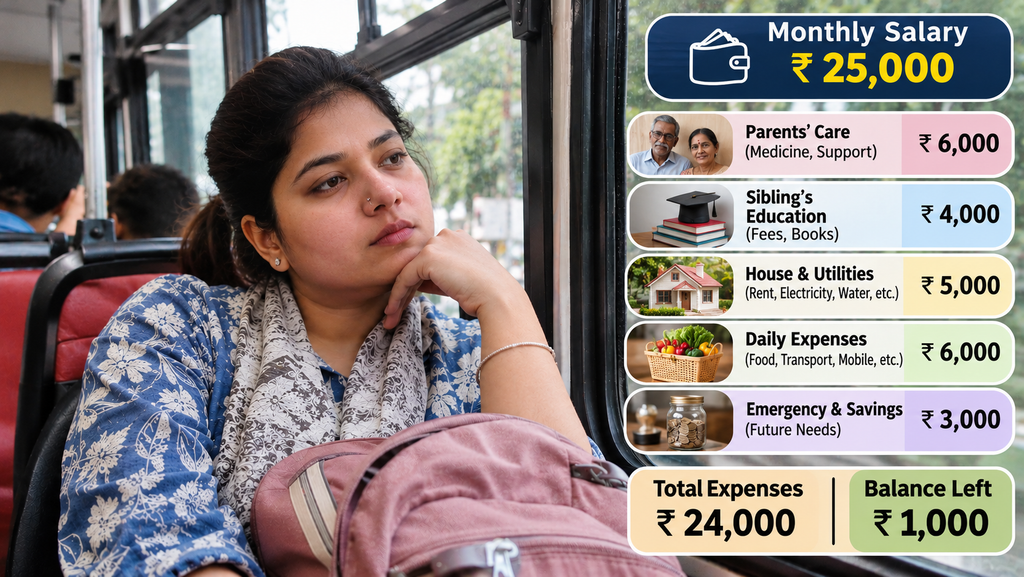
Helping your family is not wrong. But you need to be realistic about what you can afford.
If you make GH¢3,000 a month, for instance, saying yes to multiple financial requests without looking at your own expenses could leave you in a dilemma before next payday.
Figure out a reasonable sum for family support. Being financially responsible isn’t about ignoring loved ones; it’s about helping them without eternally putting yourself in financial straits.
7. Look into investment options, but do your research first
One thing is saving money. Another is deciding what to do with it in the longer term.
Young Ghanaians have several financial products to explore, including treasury bills, fixed deposits, savings accounts, and money market funds. But an investment’s popularity should never be the main reason you choose it.
In KPMG’s 2025 West Africa Banking Industry Customer Experience Survey, 43% of Gen Z respondents in Ghana said they had no investments. This presents an opportunity to improve financial literacy among young adults. Understand how the product works before you invest, such as:
- Treasury bills: These are short-term bonds issued by the government. Check their maturity dates and their current interest rates
- Fixed deposits: These may be suitable for people who can leave money untouched for an agreed period.
- Money market funds: These funds act as investments in immediate debt instruments, but returns and risks can vary.
- Savings accounts: These make it easy to access cash, but with different interest rates and charges.
- Business investments: A business investment can create growth opportunities, but it has commercial risks.
Do some research on the institution that’s offering the product. In Ghana, check the relevant regulatory authorisation, read the terms and conditions, and avoid anyone promising guaranteed excessive returns.
You don’t need to put money into all of it. It’s better to know one relevant financial product than to chase a bunch of investment trends that you don’t know about.
8. Your location can affect your savings.
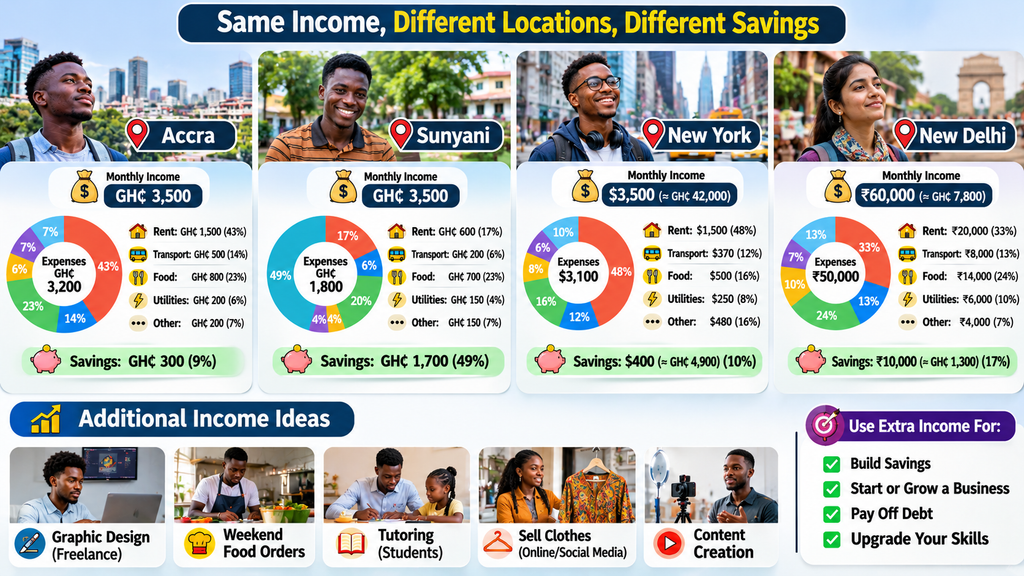
A budget that works for one city in Ghana may not work for another. Imagine two young professionals who make about the same salary. One lives in Accra and pays a lot for accommodation and daily commuting. The other lives in Sunyani, shares a room with a friend, and works closer to home.
They can earn similar amounts, but their capacity to save can be very different.
Young people in Accra should particularly take note of the costs of rent, transport, and food. Students and early-career professionals in Kumasi may need to plan around accommodation, commuting,g and campus expenses. Local employment opportunities and business expenses in communities like Takoradi, Tamale, Cape Coast, and others can influence financial decisions.
Location is also a factor in choosing a place to stay. Transportation can add a lot to your costs, especially if you have a cheap room far away from your workplace. Add up the total monthly cost of moving, not just the rent.
The same applies outside of Ghana. A young professional in Nairobi, London, or New Delhi has different living costs, but the need to plan according to local circumstances remains.
9. Generate Additional Income Without Losing Your Focus
A steady job is nice, but it’s not always going to make all your financial objectives happen. That’s why so many young adults are looking for other ways to bring in income.
A university graduate may offer graphic design services after work. A person with some cooking talent could begin taking orders on weekends. If you’re good at academics, you can offer tuition services to other students. If you’re into fashion, you can try selling clothes on social media.
Ghana’s growing digital economy also presents opportunities in content creation, online freelancing, digital marketing, and remote professional services. But side hustles require planning. Figure out how much money you need to start. Figure out who might buy your product and how much money is left after costs.
Don’t give up a steady income just because an Internet business looks good for someone else. It is also worth investing in your skills. Learning a new digital skill, improving communication, or developing practical technical knowledge may create better opportunities in time.
Extra income is only really useful when you give it a purpose. Instead of immediately upgrading your lifestyle, consider putting some of it toward savings, business development, or outstanding debt.
10. Give Your Money a Purpose & Track Your Progress
It’s hard to keep saving for no particular purpose. You may be excited initially,y only to withdraw the money a few weeks later because you haven’t decided what you are saving for. Have clear aims for your financial plans.
You might want to save GH¢3,000 in six months, buy equipment for a small business, pay off a loan you have already taken, en or build up an emergency fund.
Write down the goal and work backward. Assume no interest and no withdrawals. If you need GH¢3,000 in six months, you have to save GH¢500 every month.
Take some time at the end of each month to review your progress. Review what worked well, where you spent too much, and if your targets are still realistic. Some months will be better than others. An unforeseen family duty or job change may get in the way of your plans. That doesn’t mean you’ve failed.
The thing is to get back to your financial objectives when the situation improves.
Conclusion: Wisely Manage Finances Under 30s To Secure 40s
Your twenties are not a race to see who makes the most money, buys the newest phone, or has the most glamorous lifestyle.
For young people in Ghana and elsewhere, knowing how to Manage Finances is really about learning how to take charge of everyday decisions. It means knowing when to spend, when to save, when to invest, and when to say no to unnecessary financial pressure.

Today you may not be able to save big amounts. Perhaps you’re still looking for steady work or trying to make a little business succeed. That’s all right. Begin with what you have. Be aware of your spending, start saving, and be more inquisitive about how financial products work.
A secure financial future is infrequently the result of one great decision. More often, it’s the result of the choices you make over and over again, even when no one else is watching.