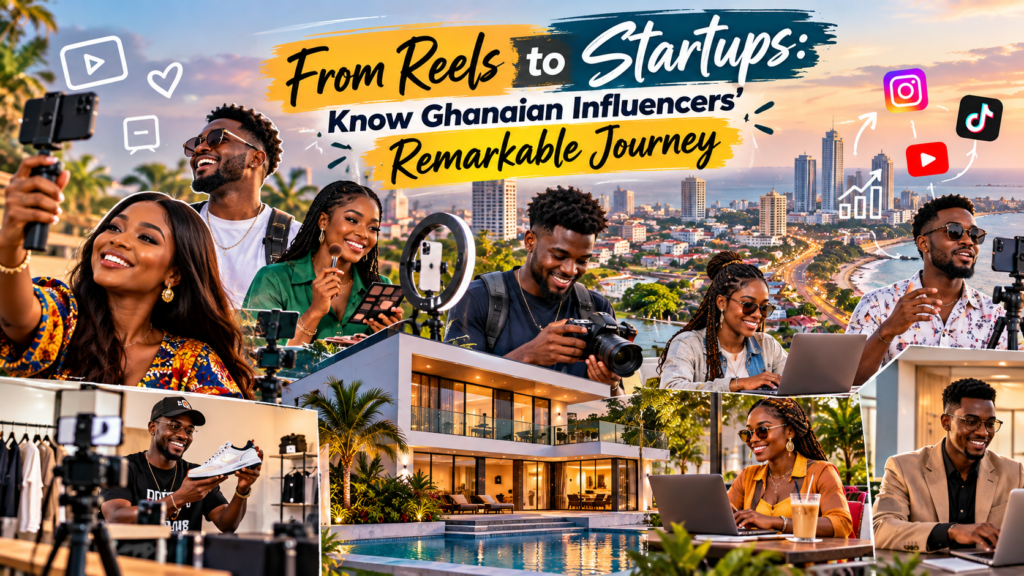
From Reels to Startups: Know Ghanaian Influencers’ Remarkable Journey
“Ghanaian Influencers are proving that one phone, one audacious idea, and some guts can open doors beyond social media.”
For many young people, a phone was once simply a way to stay connected, watch videos, or follow celebrities. Today, that same phone can become a camera, a shop, an advertising platform, a classroom, and, eventually, a source of income.
Ghana is becoming an interesting example of this digital shift.
Across TikTok, YouTube, Instagram, Snapchat and other platforms, Ghanaian content creators are finding ways to turn attention into business opportunities. Some are working with brands, some are selling products, while others are using digital income to invest in property and other long-term assets.
Recent Ghanaian reports have highlighted influencers who have publicly shown homes they say were built or acquired through income from content creation and related digital businesses.
The bigger story, however, is not simply about influencers buying houses. It is about how the meaning of digital entrepreneurship in Ghana is changing.
When a smartphone quietly became a business office
There was a time when starting a business usually meant finding a physical location, putting up a signboard,d and waiting for customers to walk through the door.
Social media has changed that journey.
Young Ghanaian influencers with a smartphone can now create videos from a bedroom in Accra, build an audience, promote a small business and reach people far beyond Ghana. Instagram, TikTok, YouTube and Facebook have created a digital marketplace where personality and creativity can become part of a business model.
Recent Ghanaian coverage has described this transformation from social-media entertainment towards entrepreneurship, with content creators using their audiences for advertising, product promotion, brand partnerships and online businesses.
That does not mean every person with thousands of followers is automatically earning a large income. Social media can produce visibility without financial stability.
But the important change is that content creation is increasingly being treated as work.
The journey from likes to land is changing the conversation
Now social media has created another possible avenue. Ghanaian influencers like Wode Maya and Dulcie Boateng are named in a recent report as creators who have openly disclosed property investments linked to their digital careers. One that has been verified is a creator who constructed a house at a very young age, and a few other content creators have shown off large properties.

The individual stories should not be taken as evidence that social media automatically leads to wealth. Property ownership, financing arrangements,s and income sources can vary considerably, and some claims are based on public statements rather than independently audited financial records.
Still, the visibility of these stories matters.
Young people watching from Accra, Kumasi, Tamale or elsewhere may begin asking a different question:
What can I build with my online audience beyond the next viral post?
That question could be more important than the number of likes itself.
Ghana’s creator economy is becoming bigger than entertainment
A creator does not necessarily need to become a traditional celebrity to build a business.
Someone who makes food videos can work with restaurants. A fashion creator can collaborate with clothing brands. A travel creator can promote destinations and hotels. A financial educator can build courses, consulting services, or other businesses.
A Ghanaian creator, for example, has built collaborations with brands across technology, telecommunications, food, beverages, and entertainment. Ghana News Agency reported that his growing portfolio demonstrates how creators are increasingly becoming part of marketing campaigns and commercial partnerships.
This is where the creator economy becomes interesting.
The real asset may not be the follower count. It may be the relationship between the creator and the audience.
Trust, consistency, communication skills, and a recognisable personal brand can become commercially valuable.
And this is not uniquely Ghanaian.
From Lagos to Nairobi, Johannesburg to London, Mumbai to Dubai, creators are discovering that an audience can become the foundation for businesses that exist outside social media.
The smartest move may happen after the viral moment
Going viral feels exciting, but a viral video does not necessarily create a sustainable career.
One Ghanaian entrepreneur and content creator, Adnan Saani, has argued that creators need to develop professional skills rather than depend solely on social-media attention. His own business activities extend into short-stay accommodation, financial education and property management.
His experience illustrates an important principle for the future of digital entrepreneurship: attention can open a door, but something useful needs to exist behind it.
For one creator, that might be real estate.
For another, it could be an online store.
For someone else, it could be photography, fashion, hospitality, education, consulting, or a technology startup.
The platform can change. The business can survive.
Why Ghana’s young creators are looking beyond the screen
There is also a cultural side to this trend.
Young people are increasingly exposed to entrepreneurs from different parts of the world through social media. A teenager in Ghana can watch a Nigerian entrepreneur building a company, an American creator launching a fashion brand, or a Kenyan influencer investing in property—all from the same phone.
That exposure can change expectations.
It may be that young people will start to see social media as a way to learn new skills, find customers and test out business ideas, as well as a source of entertainment.
Ghana’s National Youth Authority recently called on young people to stop just consuming digital content and to leverage technology to create businesses and innovative solutions.
That message reflects a wider global movement: don’t just scroll—build something.
From Accra to the world: the border is becoming less important
One of the most powerful advantages of the creator economy is geography.
A Ghanaian fashion designer can show a new collection to someone in Toronto.
A food entrepreneur in Accra can attract tourists before they even arrive in Ghana.
A travel creator can introduce Ghanaian destinations to audiences in Europe, Asia, or North America.
A property expert can educate people about African real estate without leaving the country.
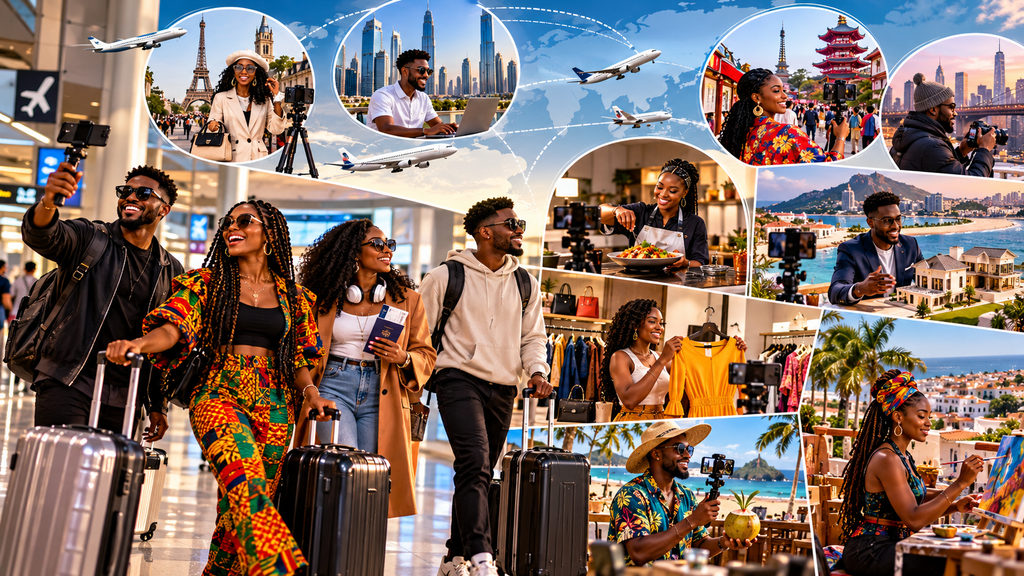
This global reach gives Ghanaian creators something previous generations did not have at the same scale: direct access to international audiences.
It also creates competition.
A creator is no longer competing only with someone in the next neighbourhood. They may be competing with thousands of creators around the world.
That makes quality, originality and credibility increasingly important.
The house is impressive, but the lesson is bigger
Young Ghanaian influencers revealing a new home can all too quickly become a luxury story.
But there is another way to look at it.
The more interesting question is how digital skills can be converted into assets.
A creator who earns money from advertising could save and invest.
Someone selling products through Instagram could eventually open a physical business.
A YouTuber could use audience trust to launch a service.
A fashion influencer could create a clothing label.
It’s not a guaranteed ride, and social media income can be unpredictable. Algorithms change, audiences move between platforms, and brand deals can disappear.
That is why financial planning matters just as much as online popularity.
From followers to foundations
Perhaps the biggest lesson from Ghana’s growing creator economy is that followers are not the final destination.
They can be the starting point.
The real achievement may come when digital attention becomes a skill, a company, a property, a product, employment for other people,e or an opportunity that continues even when the phone camera is switched off.
This is particularly relevant to young Africans searching for new ways to participate in the economy.
Ghana’s experience also connects with a much larger global story. Around the world, young people are questioning the traditional idea that a successful career must follow one predictable route: school, job, promotion, retirement.

The digital economy has created more possibilities—and more uncertainty.
For Ghanaian influencers, the next chapter may therefore be less about becoming famous and more about becoming financially independent.
The most interesting creator may not be the person with the biggest following.
It may be the person who knows what to build after getting everyone’s attention.