AI and Life: Are Trends Hampering Ghanaians’ Privacy and Trust?
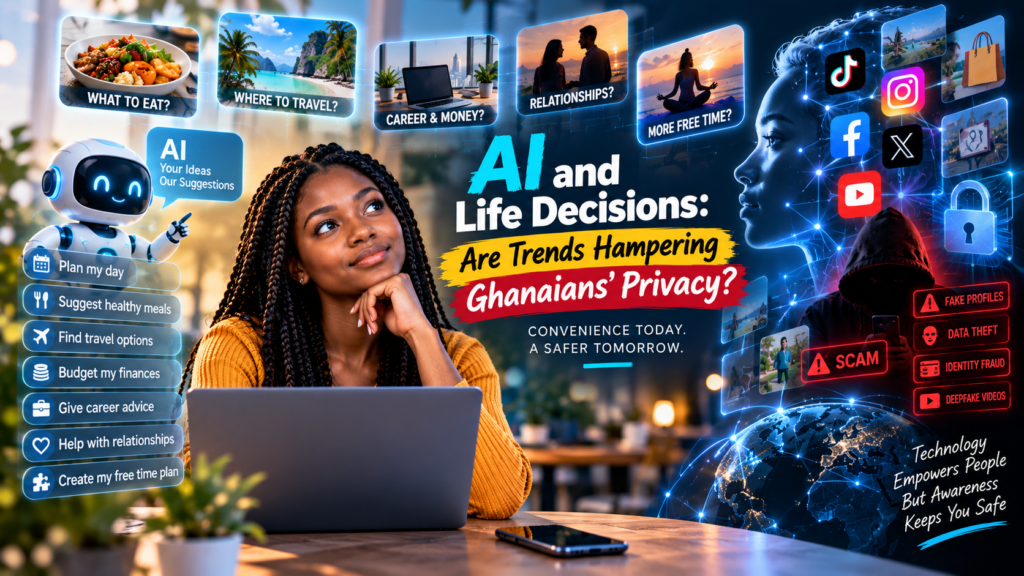
Just imagine waking up in the morning and asking AI what to eat, where to go, what to wear, and how to manage your relationships. A few minutes later, your Facebook feed is filled with ads that seem to be connected to everything you were talking about. It is convenient at first.
But then I think, how much of our personal life are we giving to technology? And who else might be watching?
Artificial intelligence is becoming a household word worldwide, including in Ghana. Digital devices are transforming the ways we find information and make decisions, from education and business to entertainment and personal productivity.
Social media has brought a new dimension to this. Trends go viral, private information is shared widely, and scammers can operate on trusted platforms to gain confidence from their victims. The worry isn’t that every AI tool or social media ad is harmful. The trick, rather, is knowing where convenience stops and privacy risks start.
This is a conversation that everyone in Ghana and the world needs to be having.
Our evolving relationship with privacy: From the 1980s to AI
Understanding how people interacted with technology decades ago can help us understand privacy concerns today.
In the 1980s, personal computers were increasingly common in offices, schools, and homes. Communication was still mostly face-to-face conversations, letters, landline telephones, and physical records. Sure, privacy concerns were definitely there at that time. It wasn’t just the internet that wasn’t as widespread; it was that financial documents, ID papers, and private conversations weren’t safe. But the scale and speed at which information was shared were different.
A photo taken at a family gathering may find its way into a photo album. A few people might be heard in a personal talk. But a mistake in public could be forgotten. Today, you can share a photo across multiple platforms in seconds. A short video can reach people in different countries. You can duplicate , store , and share a personal opinion .
The important difference is not that people in the 1980s had privacy and today’s users have none. Privacy has always needed protection, but digital technology has changed how personal information can be collected, shared, and exploited.
Social media introduced a new cultural habit: sharing bits and pieces of daily life with an audience. That habit has opened up possibilities for connection, but also requires greater awareness.
Social media trends changing everyday life.
Social media trends are not just fun videos or trending hashtags. They can shape the way people talk, shop, travel, dress, spend money and present themselves. As in many other countries, including Ghana, digital platforms are used for business promotion, social interaction, entertainment, and information sharing. The benefits are great, but we should also be aware of the risks. Let’s take a look at some key trends.
The Growth of Short Videos
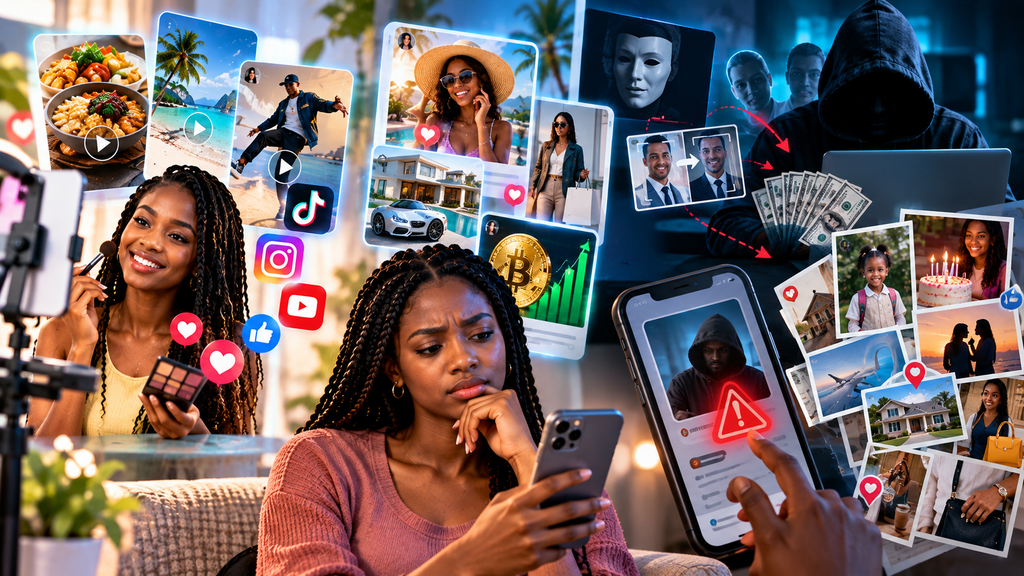
Short videos are hugely popular in the digital entertainment world now with the likes of TikTok, Instagram Reels and YouTube Shorts. A person can watch a cooking video, a travel recommendation, a financial tip, or a funny skit in minutes.
The problem isn’t short videos. The problem is that people believe something because it’s popular. For example, a video advertising an investment opportunity can attract thousands of views and comments. This visibility can produce an illusion of credibility, even when the underlying claim has not been verified.
Recently, in September 2026, Ghana News Agency reported a DUBAWA investigation about fraudulent investment scams and manipulated or deepfake videos. They also uncovered cloned news websites that targeted users with attractive and imaginary lives. The probe involved ads linked to purported AI-powered investment platforms.
Popular video isn’t automatically trustworthy video. Before sharing any personal information or making any payments, users are advised to verify the source themselves.
The Culture of Influencers and the Need to Fit In
Influencers help audiences explore new businesses, products, places, and ideas. A lot of creators also use their platforms to promote legitimate businesses and educational content. But influencer marketing can make it difficult to tell if a recommendation is personal or paid for.
Imagine you see someone advertising online:
- A fast-money opportunity
- A product for health
- An eCourse
- An investment in cryptocurrency
- Shopping site
The presentation can be personal and persuasive. But viewers cannot know if the creator has fact-checked the claims, been paid, or had their identity exploited. Scammers can also pose as public figures, journalists, and businesses. Ghana’s Cyber Security Authority has warned about fake schemes around business impersonation and online investment fraud.
Ask yourself before you trust a recommendation:
Is this person really selling this opportunity, or is someone else using his identity?
Sharing too much & Viral Challenges
Social media challenges can be fun and harmless. They can also influence users to spread information without thinking about the long-term effects. Examples are:
- Custom quizzes
- Photographs of childhood
- Birthday stuff
- Updates on relationships
- Footage of home location
- Showing off expensive purchases in public
- Questions about family members and personal background
Not every post is a serious threat. But a set of little details can show more than someone meant to. A photo may show a school uniform, workplace, home environment, or travel plans. A public birthday post can expose personal data for account-recovery questions.
The bottom line? Simple enough:
Before you post, ask yourself: would you be okay with a stranger seeing this?
AI in Ghana: Where Technology Starts to Affect Life Choices

Artificial Intelligence in Ghana creates opportunities in education, business, agriculture, healthcare, etc. AI tools can assist with writing, research, planning, language, and information organization. Imagine a young Ghanaian who is using AI to:
- Get ready for a job interview
- Come up with a cheap weekly meal plan
- Discover travel ideas in Ghana
- Pick up a new skill
- Manage your personal finances
- Search for Business Ideas
Such applications can be useful when people carefully review information and maintain control over important decisions. Another question comes up when AI gets involved in highly personal decisions.
Should AI decide our trust relations? Should it decide whether a relationship is worth pursuing? Is this what we want to allow to govern all of our free-time activities?
AI is able to offer suggestions, but it lacks full knowledge of the person’s situation, values, relationships, and cultural context. Convenience should enhance human judgement, not replace it automatically. The more personal information a user shares with a digital service, the more critical it becomes to understand the service’s privacy practices, data handling, and security limitations.
Privacy With Scammers: Digital Trust Can Be a Trap
Privacy issues become particularly acute when personal information is used for fraud.
A scammer doesn’t always have to know everything about a person. Sometimes a little information and a good story are all that’s needed to kick off a fraudulent interaction.
Fake Money Investment Opportunities
Fake money Investment scams often promise unusually high returns, encourage you to act fas,t and seem to have endorsements.
In July 2026, the Cyber Security Authority of Ghana recorded 352 cases of online investment scams with reported losses of GH¢3,429,447 during January to June 2026. The Authority urged people to look out for investment opportunities and not to be seduced by unrealistic profit promises. Fake ads can be very professional-looking. Some will use logos, news-style videos, testimonials, or references to people you know.
Please check before you invest:
- The business’s identity.
- If the company is properly authorised where applicable.
- The validity of the payment destination.
- Previous victims’ scam reports.
Never take social media advertising as confirmation of the legitimacy of an investment.
Hijacking of WhatsApp accounts
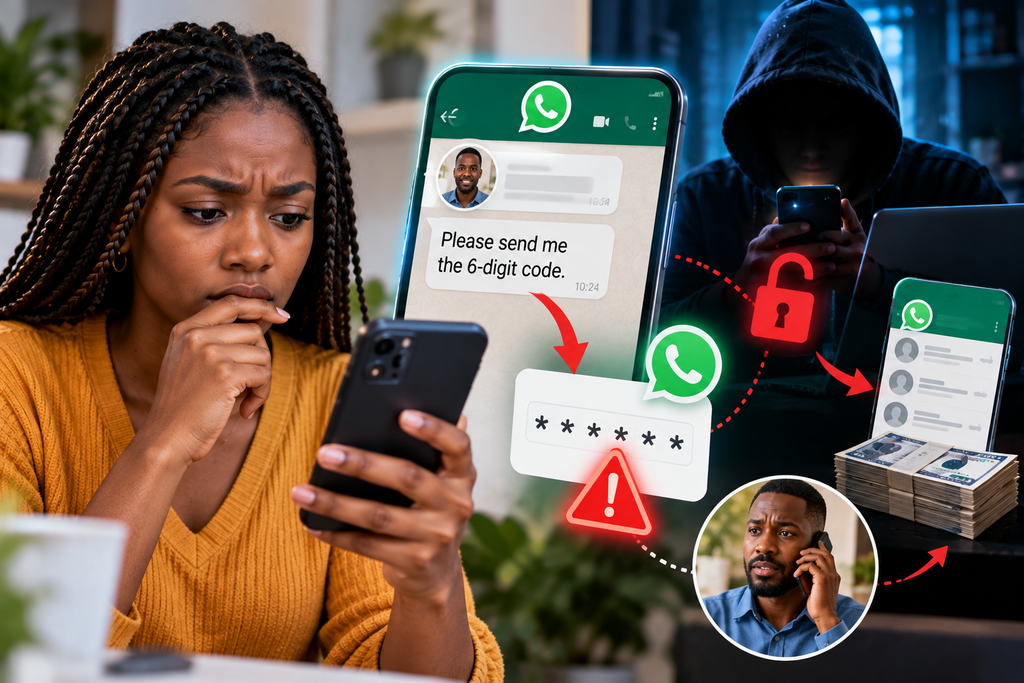
We all use WhatsApp, whether it’s to chat to family, keep in touch with work colleagues, or arrange things in the community. The Ghanaian Cyber Security Authority has warned against account takeovers, where attackers get verification codes and then use compromised accounts to ask for money or engage in other fraudulent activities.
Think of it this way:
A friend messages you on WhatsApp and asks you to send him a six-digit code.
The message looks familiar because it’s from a known contact.
But the person’s account could have been hacked.
Never give your WhatsApp verification code to anyone else. Set up two-factor authentication and be wary of strange requests, even if they appear to be friends. If you need money urgently, please verify the identity of the person asking for it on another communication channel.
Romance Scams and Emotional Coercion
Not all internet relationships are a scam. “Dating sites and social media can help people make real connections. Risk occurs when someone uses a fake identity to build emotional trust and finally asks for money, personal documents, or sensitive images.
A scammer might:
- Claim work abroad.
- Sketch a sudden financial crisis.
- Promise we will meet again.
- Request funds for travel or medical expenses.
- Request that someone keep the relationship secret.
In 2026, the Journal of Economic Criminology published a report stating the changing nature of romance fraud networks. Most of the fraudsters use ai-driven tools to honeytrap the victims. In this paper, we conceptualise romance fraud as a dynamic socio-technical phenomenon rather than a simple interaction between two people.
The practical lesson: don’t send money or sensitive information simply because you have an online emotional connection.
Are scammers more convincing because of AI?
Artificial intelligence can assist humans in doing legitimate tasks more efficiently. However, it can also be used to produce misleading content. Let’s check where scammers usually use AI for their profit. These are:
- Writing attractive messages
- To change images and clips, like Deepfake
- Make false sound
- Create fake testimonials
- Translate for different audiences, or customise content
These techniques don’t make every AI-generated image/video fraudulent. They, however, emphasise the importance of independent verification. If you see a video that appears to show a celebrity endorsing an investment, don’t just rely on the celebrity’s apparent voice or appearance. Check confirmation with:
- The person’s verified official accounts.
- The media organization alleged to be involved.
- Authorities of interest.
- Independent reporting you can trust.
Any offer that promises profits with little or no risk should put you on guard. The hidden cost of making every life choice online. Technology can make things easier, but there’s a difference between utilising digital tools and using them to make every personal decision. Even when using AI to plan a trip, a person can still choose what feels meaningful. A person who keeps up with social media trends can still decide which trends to ignore.

The trouble begins when users stop questioning what they’re told.
For instance:
- An algorithm tells you what to watch.
- An influencer suggests what to buy.
- AI suggests how to organise your day.
- A social media group tells you what to invest in.
- An online stranger offers dating advice.
On the surface, each suggestion may seem helpful, but none should be taken as gospel. Life decisions are based on values, responsibilities, relationships, and circumstances that automated systems may not fully grasp, so personal judgement is still relevant. The goal is not to repel technology. It’s about using technology and not losing control of your personal life.
How Ghanaians can safeguard their privacy in a digital world
Here are practical steps that can help users in Ghana and beyond.
1. Think Before You Share
Do not post sensitive information publicly, such as:
- Proof of identity.
- Passwords or PINs.
- Live locations.
- Personal private pictures.
2. Verify Before You Pay
Do your own business research. Beware of guarantyd returns, urgent payment requests and unknown links.
3. Secure Your Financial Information
This becomes the first step towards protection from 90% of scams. Always use strong and unique passwords unrelated to your public information.
4. Grant Necessary App Permissions
Checking the app permissions before installing an app could help you understand which app is secure to use.
5. Use AI Tools Carefully
Avoid giving the AI any unnecessary sensitive information. Review the provider’s privacy information and find out what controls you have.
6. Question Viral Content
Popularit,d comments, and slick presentation are not proof of authenticity.
7. Report suspicious behaviour
In Ghana, the Cyber Security Authority has incident-reporting channels like the 292 shortcode and the official contact information that the Authority has published. See the website for the latest guidance on reporting.

Final Thoughts: Can We Have Our Tech and Our Privacy Too?
AI and social media are not all good or all bad. They are tools and environments that people use differently.
For the Ghanaian, digital technology can facilitate entrepreneurship, learning, communication, creativit,y and personal development. At the same time, there is a need for greater awareness among individuals, businesses and institutions about the risks of online fraud and privacy. The trends of the past show us how quickly technology can change our lives, from the personal computer in the 1980s to today’s AI-powered platforms.
But one thing remains: our right to make informed choices regarding what we share, who we trust, and how we use technology. So the most valuable question to ask before adopting a new digital trend probably isn’t:
“Is everyone else doing it?”
Instead ask:
Is this making my life bette,r and do I know what I may be sacrificing to get it?
That question helps us meet AI and social media with curiosity, confidence and care.